Banning books in schools

Users who are viewing this thread

    Optimus Prime

    Well-known member
    Joined
    Sep 28, 2019
    Messages
    18,755
    Reaction score
    23,603
    Age
    49
    Location
    Washington DC Metro
    Online
    Excellent article I thought deserved its own thread
    =========================

    On the surface, it would appear that book censors and censored authors like myself can agree on one thing: Books are powerful.

    Particularly books for children and teens.

    Why else would people like me spend so much time and energy writing them?

    Why else would censors spend so much time and energy trying to keep them out of kids’ hands?

    In a country where the average adult is reading fewer and fewer books, it’s a surprise to find Americans arguing so much about them.

    In this election year, parents and politicians — so many politicians — are jumping into the fray to say how powerful books can be.

    Granted, politicians often make what I do sound like witchcraft, but I take this as a compliment.

    I’ll admit, one of my first thoughts about the current wildfire of attempted censorship was: How quaint.

    Conservatives seemed to be dusting off their playbook from 1958, when the only way our stories could get to kids was through schools and libraries.

    While both are still crucial sanctuaries for readers, they’re hardly the only options. Plenty of booksellers supply titles that are taken off school shelves.

    And words can be very widely shared free of charge on social media and the rest of the internet. If you take my book off a shelf, you keep it away from that shelf, but you hardly keep it away from readers.

    As censorship wars have raged in so many communities, damaging the lives of countless teachers, librarians, parents and children, it’s begun to feel less and less quaint.

    This is not your father’s book censorship…..

    Here’s something I never thought I’d be nostalgic for: sincere censors. When my first novel, “Boy Meets Boy,” was published in 2003, it was immediately the subject of many challenges, some of which kept the book from ever getting on a shelf in the first place.

    At the time, a challenge usually meant one parent trying to get a book pulled from a school or a library, going through a formal process.

    I often reminded myself to try to find some sympathy for these parents; yes, they were wrong, and their desire to control what other people in the community got to read was wrong — but more often than not, the challenge was coming from fear of a changing world, a genuine (if incorrect) belief that being gay would lead kids straight to ruination and hell, and/or the misbegotten notion that if all the books that challenged the (homophobic, racist) status quo went away, then the status quo would remain intact.

    It was, in some ways, as personal to them as it was to those of us on the other side of the challenge.

    And nine times out of 10, the book would remain on the shelf.

    It’s not like that now. What I’ve come to believe, as I’ve talked to authors and librarians and teachers, is that attacks are less and less about the actual books.

    We’re being used as targets in a much larger proxy war.

    The goal of that war isn’t just to curtail intellectual freedom but to eviscerate the public education system in this country.

    Censors are scorching the earth, without care for how many kids get burned.

    Racism and homophobia are still very much present, but it’s also a power grab, a money grab. The goal for many is a for-profit, more authoritarian and much less diverse culture, one in which truth is whatever you’re told it is, your identity is determined by its acceptability and the past is a lie that the future is forced to emulate.

    The politicians who holler and post and draw up their lists of “harmful” books aren’t actually scared of our books.

    They are using our books to scare people.

     
    Last edited:
    "I don't like them. I wouldn't read them. I'll be honest I've read the reviews on some of them…" With these words at a public meeting, Tennessee's Rutherford County School Board member Stan Vaught admitted to banning books he hadn't read - a revelation that kicked off a federal lawsuit.

    Three students and the writers' organization PEN America are suing the Rutherford County School Board for systematically removing more than 140 books from school libraries, including works by Nobel and Pulitzer Prize winners. The lawsuit alleges the board violated students' First Amendment rights by banning books based on personal disagreements rather than legitimate educational concerns.

    According to the complaint, board members relied primarily on BookLooks.org, a website connected to the Hitler-quoting group Moms for Liberty, instead of reading the books themselves or considering their literary merit. The board repeatedly overruled their own librarians' recommendations to keep books like Toni Morrison's Beloved and Margaret Atwood's The Testaments, and Ernest Cline' Ready Player One because it has "characters discussing beliefs that heaven and god are not real."

    The hasty removal process created chaos in school libraries. Some had to close their circulation desks as librarians scrambled to pull hundreds of books from shelves. Students were even ordered to immediately surrender checked-out copies of banned titles.

    "The Board's removal of books was-and continues to be-motivated by their desire to suppress ideas that were not in keeping with Defendant's political values," the complaint states............

    School board member admits to banning books without reading them, faces lawsuit

     
    A new wave of book bans has hit Florida school districts, with hundreds of titles being pulled from library and classroom shelves as the school year kicks off.

    The Republican-dominated state, which has already had the highest rate of book bans nationwide this year, is continuing to censor reading materials in schools, bowing to external pressures in an effort to avoid conflict and government retaliation.

    “This is an ideological campaign to erase LGBTQ+ lives and any honest discussion of sex, stripping libraries of resources and stories,” William Johnson, the director of PEN America’s Florida office, told the Guardian.

    “If censorship keeps spreading, silence won’t save us. Floridians must speak out now.”


    Book bans have been rising at a rapid rate across the US since 2021, but this latest wave comes after increased pressure from the state board of education in Florida.

    The board issued a harsh warning to the Hillsborough county school district in May, saying that if they didn’t remove “pornographic” titles from their library, formal legal action could ensue. More than 600 books were pulled as a result, and the process was expected to cost the district $350,000.

    The books taken off the school shelves included The Diary of Anne Frank and What Girls Are Made of by Elana K Arnold. None of them were under formal review by the district, and they hadn’t been flagged by local parents as potentially inappropriate. Parents with children in the school system even had the opportunity to opt their children out of a particular reading, without removing them from the class for everyone.

    PEN called the board of education’s mass removal in Hillsborough county a “state-driven censorship”, and concluded “it is a calculated effort to consolidate power through fear, to bypass legal precedent, and to silence diverse voices in Florida’s public schools,” in their press release.

    Fearing similar retribution, nine surrounding school districts have taken proactive measures, pulling books which they are worried could cause similar controversy. This includes Columbia, Escambia, Orange and Osceola, who have followed suit and quietly complied, probably to avoid similar state retaliation.

    “Censorship advocates are playing a long game, and making Hillsborough county public schools bend the knee is a huge win for them,” said Rachel Doyle, who goes by “Reads with Rachel” on social media.


    Doyle has two children in the Hillsborough school district system and is frustrated that they are being used as political pawns. She feels that her voice has been erased by far-right groups like Moms for Liberty and that parental rights groups do not have her kids’ best interests in mind.

    “I do not want or need a special interest group or a ‘concerned citizen’ opting out for me,” Doyle said. “Once Florida becomes a place where this is the norm entirely, other states will follow.”……..

     
    Spread to Canada
    ==============
    The Canadian province of Alberta says it will temporarily pause its controversial book ban “to ensure that our classic literary works remain in school libraries” after novels, including several warning of dystopian government overreach, were pulled from shelves.

    Premier Danielle Smith said the temporary pause would allow officials time to rework new rules that focus on how gender identity, sexual orientation or human sexuality are discussed in classrooms.

    “It’ll be paused for a couple of hours while the ministerial order is rewritten,” she told reporters on Tuesday afternoon. “The direction will be to take books with pornographic images out of the libraries and to leave the classics alone. I think that there was some misunderstanding of the order, so it’s being made clear.”

    The rules, set to go into effect on 1 October, reflect a lobbying success by socially conservative “parents’ rights” groups in the province and mirrors a trend in the United States.


    But the ambiguity over what constitutes “explicit sexual content” has also provoked protest from school boards.

    Highlighting what it felt were inconsistencies in the new rules, Edmonton’s school board drew up a list of more than 200 books it said must be removed from library shelves in order to comply with the ministerial order.

    Among those books were dystopian classics such as The Handmaid’s Tale by Margaret Atwood, 1984 by George Orwell and Brave New World by Aldous Huxley. The Color Purple by Alice Walker and I Know Why the Caged Bird Sings by Maya Angelou were also targeted, as were Jaws by Peter Benchley and It by Stephen King.…….

     
    Spread to Canada
    ==============
    The Canadian province of Alberta says it will temporarily pause its controversial book ban “to ensure that our classic literary works remain in school libraries” after novels, including several warning of dystopian government overreach, were pulled from shelves.

    Premier Danielle Smith said the temporary pause would allow officials time to rework new rules that focus on how gender identity, sexual orientation or human sexuality are discussed in classrooms.

    “It’ll be paused for a couple of hours while the ministerial order is rewritten,” she told reporters on Tuesday afternoon. “The direction will be to take books with pornographic images out of the libraries and to leave the classics alone. I think that there was some misunderstanding of the order, so it’s being made clear.”

    The rules, set to go into effect on 1 October, reflect a lobbying success by socially conservative “parents’ rights” groups in the province and mirrors a trend in the United States.


    But the ambiguity over what constitutes “explicit sexual content” has also provoked protest from school boards.

    Highlighting what it felt were inconsistencies in the new rules, Edmonton’s school board drew up a list of more than 200 books it said must be removed from library shelves in order to comply with the ministerial order.

    Among those books were dystopian classics such as The Handmaid’s Tale by Margaret Atwood, 1984 by George Orwell and Brave New World by Aldous Huxley. The Color Purple by Alice Walker and I Know Why the Caged Bird Sings by Maya Angelou were also targeted, as were Jaws by Peter Benchley and It by Stephen King.…….

    Parents’ rights is a pile of bullschlitz. It is none of any parent’s business what a kid who is not their kid reads. Tell your kids not to read them. Hopefully, when they are older they will and expose their parents for the buffoons they are.
     
    When a junior at an Orange County public high school in Florida visited the school library to check out a copy of “On the Road” by Jack Kerouac, it wasn’t in its Dewey decimal system-assigned location.

    It turns out the title had been removed from the library’s shelves because of a complaint, and in compliance with Florida House Bill 1069, it had been removed from the library indefinitely. Kerouac’s quintessential chronicle of the Beat Generation in the 1950s, along with hundreds of other titles, was not available for students to read.

    Gov. Ron DeSantis signed the bill into law in July 2023. Under this law, if a parent or community member objected to a book on the grounds that it was obscene or pornographic, the school had to remove that title from the curriculum within five days and hold a public hearing with a special magistrate appointed by the state.

    On Aug. 13, 2025, Judge Carlos Mendoza of the U.S. Middle District of Florida ruled in Penguin Random House v. Gibson that parts of Florida HB 1069 are unconstitutional and violate students’ First Amendment right of free access to ideas.

    The plaintiffs who filed the suit included the five largest trade book publishing houses, a group of award-winning authors, the Authors Guild, which is a labor union for published professional authors with over 15,000 members, and the parents of a group of Florida students.

    Though the state filed an appeal on Sept. 11, 2025, this is an important ruling on censorship in a time when many states are passing or debating similar laws.

    I’ve spent the past 26 years training English language arts teachers at Arizona State University, and 24 years before that teaching high school English. I understand the importance of Mendoza’s ruling for keeping books in classrooms and school libraries. In my experience, every few years the books teachers have chosen to teach come under attack. I’ve tried to learn as much as I can about the history of censorship in this country and pass it to my students, in order to prepare them for what may lie ahead in their careers as English teachers..............


    Weston Brown was scrolling through Twitter one day in 2022 when he came across a video of his mom Monica Brown calling for LGBTQ+ books to be removed from school libraries at a school board meeting in his hometown of Granbury, Texas.

    Weston, who was raised a Fundamentalist Evangelical Christian, knew right away that he needed to speak up, so he connected with locals and returned home to advocate against book banning at a school board meeting himself.

    There, he addressed an audience that included his mom, saying, "It’s been nearly five years since I came out to my family. I'm not allowed to join in family celebrations or holidays, or be part of my eight siblings' lives, all because I’m not straight. I’m here to implore you to listen to librarians, educators and students, not those speaking from a religious perspective or at the bidding of a political group."

    "If you choose to marginalize differences and remove representation, you will only cause harm,” he continued.

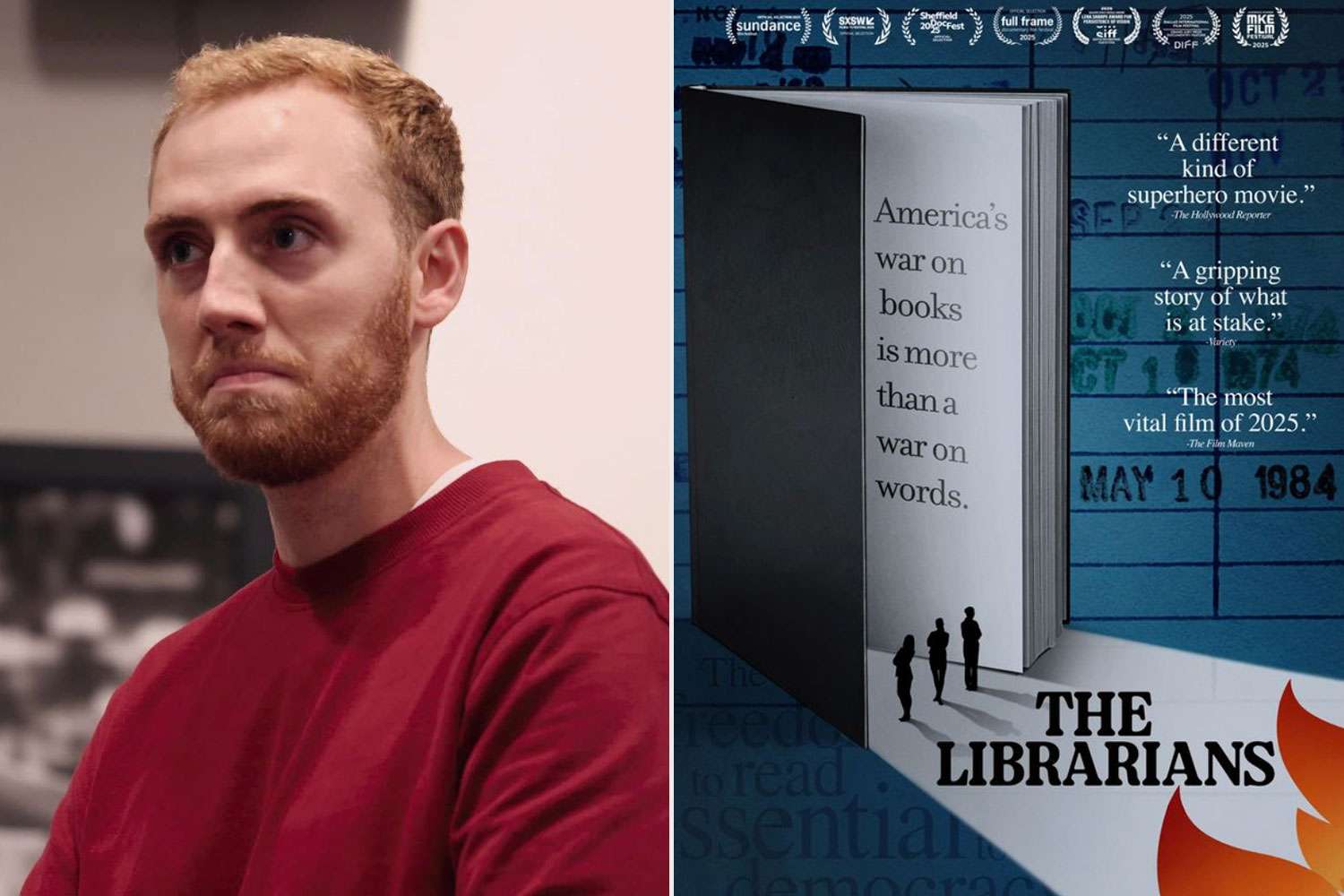
    The young man’s story is showcased in Kim A. Snyder’s new documentary The Librarians, which dives into book bans sweeping across the United States and how it affects librarians, community members and students.

    Speaking exclusively with PEOPLE, Weston, now 31, explains that his involvement in the documentary came naturally as the film crew was already at the school board meeting he attended. But looking back on where it all started, he says he felt motivated to reclaim his story after he saw the viral video of his mom.

    "I had reached a point where enough time had passed after some tumultuous things that had happened in my life previously, that I was ready to reengage, take some power back in the conversation and add my voice to the story," he says.

    The wave of book bans in Texas, at the time, was sparked by the then-Texas State Representative Matt Krause, who released a list of 250 books that he felt needed to be removed from schools and libraries. The list contained many titles focused on race and sexuality. While no direct plan of action was announced, the former politician requested that schools and libraries report back on whether any of the books were on their shelves and where the funding for them came from.

    Weston recalls feeling shocked to see his mom involved in the censorship movement, as neither he nor his siblings ever attended public school. However, he knew the issue went far beyond his estranged relationship with her and his conservative upbringing.

    "I, through a number of years of therapy, time and healing, had really come to a place where I wasn't there with a message for my mom or even a confrontation for my mom," Weston says. “I was there for a message for the board, for teachers, for educators, for those who were willing to listen. That gave me strength because the work of trying to break through and communicate with my mom is really too heavy of a burden for me."............

     
    What a loss this mother has inflicted on herself and her family. She is the one suffering from hate.
     
    In what intellectual freedom advocates have seen coming for months, a Texas school district has just shut down access to all secondary school libraries for students due to the regulations of the state’s Senate Bill 13.

    New Braunfels Independent School District (NBISD) voted yesterday, Monday, October 13, to shut down all but elementary school libraries in the district in order to ensure their collections are compliant with the law.

    Senate Bill 13 (SB 13) requires that school libraries remain free of “harmful material,” “indecent content,” and “profane content.”

    All three of these designations lack any legal definition, opening wide the door for interpretation and undermining the federal standard of the Miller Test in determining obscenity.

    Laws like SB 13 have been appearing in state legislature nationwide, with the intention to dismantle shared understanding of obscenity in favor of partisan-flavored interpretation of what does and does not constitute “inappropriate” material in books.

    SB 13 goes further than requiring schools remove such materials. It gives the power of selecting what materials may be added to public school libraries to either the district’s board of trustees or to parent-led committees called School Library Advisory Councils (SLACs).

    Districts can choose which method they’ll take to oversee the collection, though local parents can petition districts who don’t elect to go with the SLAC options to do just that.……….

     
    Oct. 22 (UPI) -- A federal judge has ordered the Department of Defense to return nearly 600 books on race and gender to libraries at several U.S. military schools, ruling that President Donald Trump's executive orders that led to their removal likely violate the First Amendment.

    U.S. District Judge Patricia Tolliver Giles on Monday ordered the books to be restored to the libraries of five schools on U.S. military installation in Virginia, Kentucky, Italy and Japan, while barring the Trump administration from further altering their curriculum.

    "This ruling is a solid first step in a long road to restoring and protecting students' freedom to read in schools run for military families, and we hope this decision will serve as useful precedent in other courts," PEN America's Freedom to Read Program Director Kasey Meehan said in a statement Tuesday.

    Since returning to the White House in January, Trump has led a charge to remove left-leaning ideology from government, public and private spaces via his executive powers.

    Three executive orders issued by Trump in January directed the removal and prohibition of material concerning gender ideology, so-called divisive concepts on race and sex and gender ideology as well as "un-American" theories from the federal government and K-12 schools.

    In March, the Department of Defense Education Activity began removing books, such as ABC of Equality and You Call This Democracy? from its 161 schools in 11 foreign countries, seven states and two territories.

    The next month, six families of 12 students ranging in age from pre-kindergarten to high school sued the federal government to stop the Trump administration from banning books and material it finds politically incorrect, arguing the "system-wide censorship" was a violation of their First Amendment rights.

    In her ruling granting the plaintiffs a preliminary injunction on Monday, Giles stopped short of ordering the Pentagon to restore the pulled books to all of the DoDEA schools and only directed it to return the books to the five schools the plaintiffs attend.

    "Plaintiffs have demonstrated a likelihood of showing that Defendants' stated motivations for removing over 500 library books set forth an impermissible partisan or political motivation," the President Joe Biden appointee said.................


    A Kansas City judge this week struck down a Missouri law that banned "explicit sexual material" from schools and led to the removal of hundreds of books from local districts.

    Jackson County Circuit Court Judge J. Dale Youngs, in a ruling on Monday, found that the 2022 law was too vague and broad and violated the Missouri Constitution.

    The brief, five-page ruling did not offer specifics based on his decision. But the order marked a win for Missouri library associations, which sued over the law in 2023 arguing that it forced schools to remove from their shelves scores of books and classic novels.

    The 2022 law was part of a broader, coordinated effort by conservatives in Missouri and across the country to curtail the contents of school books. The sweeping culture war push also resulted in lawmakers briefly attempting to cut library funding in 2023 in response to the lawsuit.

    Jenn Baldwin, president of the Missouri Association of School Librarians, championed the ruling in a statement on Wednesday, saying it restored librarians' "ability to support students' literacy without fear of arbitrary enforcement."

    "This decision affirms our work as Missouri school librarians to respect parental rights to help their own children select diverse books appropriate for them," said Baldwin.

    Baldwin's association and the Missouri Library Association were represented in the lawsuit by the American Civil Liberties Union of Missouri and the Stinson law firm.

    The law threatened librarians or other school employees who violate it with a misdemeanor, risking up to a year in jail or a $2,000 fine. After it took effect, districts across the state pulled hundreds of titles from school libraries.

    In the Kansas City area, Independence schools removed a dozen graphic novels from library shelves, including a comic book version of Kurt Vonnegut's American classic "Slaughterhouse-Five," the iconic graphic novel "Watchmen" by Alan Moore and Dave Gibbons, "Blankets" by Craig Thompson and "Home After Dark" by David Small, according to records previously obtained by The Star.................

     
    Utah public schools have banned Gregory Maguire’s 1995 novel, Wicked: The Life and Times of the Wicked Witch of the West, for good.

    The dark fantasy that reimagined author L. Frank Baum’s The Wonderful Wizard of Oz,from the wicked witch’s perspective, is now among dozens of titles from the Utah State Board of Education’s list of banned books…….

     
    could have gone in a number of threads
    =============================

    For the past few years, Gov. Ron DeSantis and GOP legislators have been on a censorship tear that would make 17th-century book-burners offer a round of Puritanical applause.

    They’ve targeted books that promote diversity, that discuss LGBTQ issues — even a high school math book that they believed somehow wove Critical Race Theory into pre-calculus lessons.

    But one of the most dangerous things they’ve done is whitewash history, targeting lessons that tell harsh truths about this country’s past.

    The historical censorship is designed for people with closed minds and fragile sensibilities who want to believe minorities never endured “systemic” discrimination and don’t want any facts getting in the way of their opinions.

    Now DeSantis’ appointees have intensified the whitewashing by gutting a collegiate sociology textbook that discusses racism and gender inequality.

    As the Orlando Sentinel recently reported, the gubernatorial appointees who oversee the state’s university system recently approved disemboweling an intro-to-sociology textbook, removing more than half of its content, including an entire chapter on “Race and Ethnicity,” which are pretty key concepts in sociology.

    When the erasure enthusiasts were done, they had deleted more than 400 pages from a textbook that originally had 667, a slew of examples about how women have experienced gender discrimination and almost all references to racism.

    History lessons in the “Free State of Florida” are now often free of facts and uncomfortable truths.

    Though the original book examined social movements from recent years, Florida’s historical hackers decided to pretend like many largely never existed, all but erasing references to how America reacted to the killing of Black Americans like Trayvon Martin and George Floyd.

    In the original version, trailblazer Shirley Chisholm was mentioned nine times when examining why it took this country nearly two centuries to elect a Black woman to Congress. In the new version, Chisholm is relegated to a single footnote.

    The word “racism” appeared 115 times in the original manual. By the time the censors were done, it was only six.

    I guess that’s one way to try to convince people that racism doesn’t exist — just erase every piece of evidence that proves otherwise.

    But let’s be clear: It does.

    If you need recent evidence, check out this stomach-turning headline from just this past week: “‘Nazi heaven’: Inside Miami campus Republicans’ racist group chat.”

    The Miami Herald reported that students in this group chat used “variations of the n-word more than 400 times,” “wrote dozens of ways of violently killing Black people” and reveled in antisemitism.

    There’s your target audience for this state’s anti-diversity initiatives — the young adults who proudly proclaim that they “avoid the coloreds like the plague” and that they “would def not marry a Jew.”

    It’s easy to be repulsed by such sentiments. The tougher and arguably more important thing to do is study them to understand how they came about. That’s part of what sociology does.......................

     
    Louisiana public school librarian Amanda Jones loves helping kids find the right book.

    It’s her 25th year working in the Livingston Parish school district, the same one she attended as a kid. In 2022, she spoke at a local public library hearing about a challenge to remove a book about teen puberty, sexuality and consent from the shelves. She showed up with other community members to argue against banning any books from public libraries.

    Soon, social media attacks started. She says commenters called her a "groomer" and a pedophile, publishing the name of her school and saying she was giving children pornography and erotica. Jones thought no one would believe them, but they did. She says she didn’t leave her room for four days, crying so hard her eyes swelled shut. She had debilitating panic attacks and was in and out of the hospital for two months. Jones brought a defamation lawsuit against a pair of conservative bloggers – seeking damages of $1 and an apology – that's still ongoing. Whatever happens, she says she’s committed to staying on the job.

    Later, Jones would become one of the faces of the fight against book banning. She has since published a book about her experience called “That Librarian” and made it on TIME100 Next (with an appreciation written by actor and avid reader Sarah Jessica Parker).

    Jones is just one example of a new landscape that teachers in America are navigating amid increasing book bans and public pressure.......

    Heather Garcia, a librarian in Tallahassee, Florida, for 14 years, says she’s seeing some of the book ban fever break.

    She points to a dispute over a Billie Jean King biography, "I Am Billie Jean King," in her district. An elementary grade parent filed a complaint asking the biography be removed from the school because "I object to material that discusses being gay and what it means to be gay." After a hearing, the book remained on the school shelf.

    “I think that kind of sent a clear message at least in our district that we were not here to let one group decide what all children should read,” Garcia tells USA TODAY. “They were welcome to decide what their own personal children read, but they were not welcome to be the deciding voice for all children.”


    As for the spirit of the banning, which saw her and others take on the “herculean task” of going title by title in both the school library and the personalized classroom libraries of each teacher, Garcia says she thinks it was “targeted at marginalized voices, authors of color, LGBTQ narratives” and “addressing historical truths.”

    “You always want your kids to have … critical thinking and empathy and respect for others and other cultures,” she says. “When you’re reading a book, you’re not looking in a mirror. … You’re looking at a window.”

    As for the igniting emotion behind the parents hoping to pull certain titles, Garcia says, the group is a lot smaller than you might think.

    “I don’t feel that it’s so many parents. I think it’s so few very loud parents.”..............


    Create an account or login to comment

    You must be a member in order to leave a comment

    Create account

    Create an account on our community. It's easy!

    Log in

    Already have an account? Log in here.

    General News Feed

    Fact Checkers News Feed

    Back
    Top Bottom